
14 Nov 2012
Can I Get a Discount?
Which question from your prospects and customers scares you the most?
If you are like most business owners we work with, you will probably answer:
- How much does it cost?
- Can I get a discount?
- Why should I choose you and not your competitor? or
- Can you provide a guarantee?
While all of these are intimidating and sometimes difficult to overcome, they all have one positive thing in common – your prospect is giving you a signal that she is interested in buying from you but she needs for you to help her overcome her objection. She has already started to think about trying your product/service but she is unsure about at least one aspect.
And for that reason – you can take those questions as a sign that a sale is in fact still possible.
However, the question that should frighten you more than any other because it is by far the worst one that you get from your audience is – Can I have some time to think about it?
Thinking is counter-productive to deciding. Whenever you put your prospect into a position where they have gone into the thinking part of their brain, you will not get a decision. Thinking takes place in one part of your brain (the neo-cortex), while deciding happens much more quickly (and automatically) in your old or “reptilian” brain.
Let’s examine where you went wrong…
The biggest part of your brain is the neo cortex. It is the last thing that forms in the womb and it lights up when we listen to music, look at colours, speak, read and process numbers. If you ever hear people talking about right vs. left brain thinking, they are talking about the neo cortex. In a nutshell – this part of your brain THINKS.
So when your customer says “I need to think about it” this part of the brain is firing up and looking for data. Neuromarketing research has revealed that this uses up tons of her brain energy and prolongs the decision making process. So, if you want to drag out the process of getting your customer to decide or compete on price, you want to make sure that your customer has to us this part of her brain. Make sure you give your customer lots of BIG words, numbers, graphs, lists of features and benefits, talk about your competitors and how you stack up next to them – and your customer will NOT decide <that is guaranteed> buts he will do a whole lot of thinking and take up more of your valuable time and energy in the process.
If you want to get your customer to decide, you must tailor and deliver your message to her old (reptilian brain). It lights up even before she has conscious awareness that she has made a decision. Now, while it is very true that this is the most primitive part of her brain, the good news is that it is very predictable. By understanding how this part of the brain works, you will never again bore and overwhelm your customers AND you will never again be lured into the trap of having your audience tell you that they need to think about it.
How will you do this? By understanding how this part of your customer’s brain works, you can help her to use the least amount of mental energy in processing your message which means that she will make quicker decisions. It is important to remember that unlike the neo-cortex (the thinking part of her brain), this part right of her brain is automatic – it does not think, it only DECIDES and ACTS. It is always at work scanning her environment looking for information of value to her survival. In order to avoid having your customers ask for time out to think about whether they need your product/service, you need to grab their attention up front quickly, deliver your strongest claim first and show her how your solution is going to solve her primary source of pain. This is the essence of Step 1 in the Sales Seduction process.
 I got a 15 page sales letter the other day from a marketing coach trying to convince me to attend his seminar. It was the perfect example of what NOT to do. If you want to attract more clients and make it easier for them to say “Yes” to working with you, you will want to pay particular attention to what I am about to share with you right now.
You may not know this but there are reportedly over 14,000 sales and marketing books on Amazon – and most of them (like the email from this coach) deal with techniques and strategies that cause your prospects to waste valuable time and energy thinking. Without realizing it, these techniques cause your audience to have to use their neo cortex (the thinking part of their brain) to process what you are saying.
While some of these techniques may work for some of the people some of the time, they are not reliable or predictable because they are designed to trigger the wrong part (the thinking part) of your prospect’s brain.
So, what do top sales and marketing coaches do to help their audience to decide quickly?
Clearly there are some principles that work – there is a process to marketing and selling products and services effectively. However, some of these principles (while valuable) have been taken to the extreme by many experts and coaches. In doing so, they dilute your message and make it ineffective. Without realizing it, these strategies will kill your ability to close sales because they will make it difficult for your audience to decide anything.
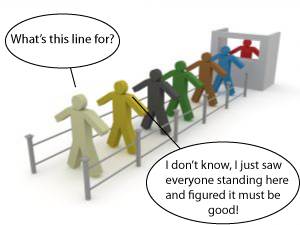
For example, I’m sure you have heard of the concept of “social proof”. This was first proposed by Dr. Robert Cialdini and it essentially means that before people decide, they will often look to what other people do before making their decision. It explains why customers will choose to go to a restaurant that is full and has a line up outside ,when the one next door is almost empty and there are plenty of tables available.
According to Cialdini, you will assume that the busy restaurant must be better because others have decided to eat there. Social proof is an important driver and on some level, it does help your brain to make decisions more quickly. Your customer wants to find a solution to her pain but she is also afraid of taking a risk. Social proof is one factor that can help to swing the balance in favour of your product or service.
However, too often this principle is taken to the extreme. Take my example of the marketing coach who sent me a ridiculously long sales letter. 5 out of 15 pages were designed to show you how many people have used and love his products. Does this seem like a bit much to you? Is it possible that his long winded letter (while paved with good intentions to provide social proof), might have had the undesired effect of causing the audience to engage the thinking part of their brains… and ask for more time to “think about it”?
Social proof is a great tool in your marketing belt but it is not as effective as understanding the 7 Stimuli that trigger the decision making part of your customer’s brain. Knowing these 7 simple and effective triggers, can transform how you talk to your customers and the results you achieve. And the 7 Stimuli which trigger the part of the brain that decides, are part of my simple, step-by-step process called Sales Seduction. Sales Seduction, is based on neuromarketing principles, and it can help you go from confusing your prospects, to convincing them.
17 Oct 2012
Point. Set. Love Your Financials!
 Imagine you are playing an important game of tennis…
It’s the club final and you are the favourite to win. There is a big crowd watching and as the game progresses, everything seems to be going to plan. You’re playing well and you’re winning points. Victory can’t be far away. There is only one problem: there is no scoreboard, and the umpire is keeping the score to herself. So no one except the umpire knows what’s really going on.
Nevertheless, you plough on and, despite being in the dark about the score, you feel positive that eventually the umpire will declare you the winner. You are so confident that you can’t help but relax just a little. You start enjoying the party like atmosphere.
Then a shock! Out of the blue, the umpire declares that it is match-point … to your opponent! You can’t believe it. You go back to the baseline, determined, and set yourself up for this big point. But to no avail. It’s too late to get your mind back into gear and you hit the return wide. The game is over, the final is lost. If only you’d been able to track the score during the game. At least you would have been able to fight back a little bit earlier.
Every day, hundreds of businesses, big and small, operate as though they are playing a game of scoreboard-less tennis. Every month the owner runs on feelings for most of the month – no more than a guess about how well the business is travelling. A day or two after the month ended, you will look to the ‘umpire’ – your accountant – who will give you the ‘score’ – your figures. And most times, his perceptions will have proven inaccurate and it is far too late to do anything about it. When things changed in the business – when your ‘opponent’ started to get on top – you simply would not have seen it coming.
Your financials are to your business what the main scoreboard is at a sporting contest. Can you honestly say that you know where you are and where you are going?
Do you often look at your reports and wonder what they mean?
Do you waste money and time chasing new customers instead of fixing your business and making it profitable?
If you are ready to get serious about your business… it’s time for a little Financial Foreplay®.
It’s time you learned:
· Why cash, more than profit, is the key to success in business;
· How to find and unlock the hidden profit and cash that is trapped in your business;
· How to use the numbers in your financial statements to give you information that is useful for you – not just useful for your accountant. For instance, I’ll show you how to calculate a few simple but important ratios, to understand the results and to monitor them on an ongoing basis;
· How to stop making common business mistakes that are preventing you from being as successful as you deserve to be;
· Why too much inventory can strangle your business;
· How to manage debts owed to you and minimize the risk of default;
· How to charge the right price for your goods and services;
· How to decide whether an investment will be a good use of your company’s money or not;
· How to work out when, during each month, you ‘hit the front’ and start being profitable;
· How to set powerful and meaningful targets that will focus the attention of both yourself and your staff on making good decisions and taking positive actions ALL the time;
· A way to measure and track your financial success in a simple and meaningful way; and
· How to eliminate the unproductive habits that have been holding you back.
You will learn all this through the stories of my clients. Powerful stories about real business owners, just like you, with common financial problems. I’ll show you how these business owners found themselves in trouble, how they worked out what was wrong (with a little help from the financial numbers) and how they took action to turn things around.
02 Oct 2012
Can You Offer it at a Cheaper Price?

Do Your Prospects Often Ask You For a Cheaper Price?
What would it be worth to you if you could STOP competing based on price?
Knowing this valuable information before you craft your next sales or marketing message, can help you to influence your customer to decide quickly and make price a non-issue.
If your sales process is currently taking too long, this information will help you close sales faster.
If your customers need to “think about” doing business with you, this information will help you to stop boring and confusing them.
If your customers keep asking you for a better price, I am going to show you how to get the price that you deserve.
We now know there are 3 distinct parts of the brain and each one of them has a different function. However, only 1 of them is responsible for decision making and it fires up around 8 seconds before you are consciously aware that you have even made a decision. The research and information I am about to share with you hasn’t come from psychology, the personal development industry or even a marketing agency – these findings were made by neuro scientists, medical doctors studying brain wave activity with FMRI machines. They were looking to find out which part of your brain lights up when it is presented with different stimuli and the findings have been documented and published in respected publications like the Wall Street Journal and the Harvard Medical Journal.
The biggest part of brain is the neo cortex. We are the only species on the planet that has developed this part of the brain. It is the last thing that forms in the womb and it lights up when we listen to music, look at colours, speak, read and process numbers. If you ever hear people talking about right vs. left brain thinking, they are talking about the neo cortex. In a nutshell – IT THINKS.
Similarly, when your customer says “I need to think about it” or “is this the best price I can get?” this part of the brain is firing up and looking for data. This uses up tons of your brain energy and prolongs the decision making process. So, if you want to drag out the process of getting your customer to decide or compete on price, you want to make sure that your customer has to us this part of his brain. Make sure you give your customer lots of BIG words, numbers, graphs, lists of features and benefits, talk about your competitors and how you stack up next to them – and your customer will NOT decide <that is guaranteed> but he will do a whole lot of thinking and take up more of your valuable time and energy in the process.
Let’s move on to the middle or mammalian brain – this right here is the part of the brain that we share will every warm blooded creature on the planet. This is where you process emotions and feel. But this is not where you make decisions.
At the top of your spinal cord, there is a collection of neurons – which are commonly referred to as the old or reptilian brain. This is the first part of your brain that is formed in the womb and it is the part that keeps you alive – all bodily functions that take place below the level of consciousness, are controlled by this part of your brain.
It is your fight or flight brain – and its sole responsibility is to ensure your survival. It houses the amgydala – which is the chemical factory in your brain that regulates all bodily functions. And it is the part of the brain that lights up when you DECIDE.
It lights up even before you have conscious awareness that you have made a decision. Now, while it is very true that this is the most primitive part of your brain, the good news is that it is very predictable. By understanding how this part of your brain works, you will never again bore and overwhelm your customers AND you will never again be lured into the trap of competing based on price.
How will you do this? By understanding how this part of your customer’s brain works, you can help him to use the least amount of mental energy in processing your message which means that he will make quicker decisions. It is important to remember that unlike the neo-cortex up here (the thinking part of your brain), this part right of your brain is automatic – it does not think, it only DECIDES and ACTS. It is always at work scanning your environment looking for information of value to your survival.
So you might be wondering how does this apply to the price that you charge for your product or service? Just for a moment, I want you to imagine that you are in the business of selling pizzas. Now, it doesn’t matter whether your business is called Pizza Hut, Dominos, Eagleboys, Boston Pizza or Pizza World… you are basically selling an undifferentiated product and the market that you find yourself in looks price conscious, doesn’t it? The reason for that is simple – the consumer finds it hard to distinguish between your pizza and the next guy.
Now if you happen to BE the owners of a Chicago Deep dish pizza shop you might argue that your pizza is better because your crust is thicker and you provide more toppings and value. But in the eyes of the consumer, your pizza is still not really worth much more than the next guy’s pizza. You might be charging $20 and your competitor is charging $18.50. Why is that?
It’s because even though you think there is a difference, in the eyes of your customer, there isn’t. 95% of what you and the next guy offer are essentially the exact same thing. And as long as you keep operating in that zone with a marketing message that doesn’t stand out and stake a claim, you will continue to compete on prize because your customer is up in his neo-cortex trying to figure out which pizza is the best one to order.
So knowing this, what could you do differently? Well one company in 1973 identified a way to stand out and grab market share. It didn’t claim to have the best, the thickest or even the cheapest pizza, it just made you a promise that if you ordered from them, you would get it in 30 minutes or your pizza was free. It was the most successful campaign in the history of the industry – for good reason.
Think about it, when you order a pizza, what is the one question that you have in the back of your mind? I wonder when the pizza will get here?
Dominos answered that question for you. They stopped making you need to think about it and they triggered the part of your brain that decides and dials.
This is the power of Sales Seduction – understanding why your customer says YES and helping him to say YES to your product/service. Can you see now how knowing this information can help you accelerate your sales process, close more business, trigger decisions and allow you to charge a fair price for your product/service?
Great – so your homework today is to go back through one of your sales or marketing messages and identify all the ways that you are boring or overwhelming your prospects. The key to NOT competing on price ever again, is in making it easier for your customers to say ‘YES’.
12 Sep 2012
What Does Your Executive Summary Say About You?
 While only 2 pages in length, the executive summary is by far the most important component of your business plan or proposal. It is designed to summarize the key elements, capture attention and most importantly, showcase the financial highlights.
So, if you only have 2 pages to convey a significant amount of information and summarize the financial upside, how do you decide what to put in and what to leave out? Which financial features are critical to emphasize?
Depending on the purpose of your document and the intended audience (investment, sale, partnership, strategic alliance, joint venture etc.), you will want to tailor your financial disclosure to suit their needs and expectations. What would they want/need to see in order to make an informed decision?
At a minimum, you need to clearly state what financial input is required from them and what they will get in return – i.e. a share, debt instrument, license, exclusive right etc. Next, highlight the expected net profit and cash flow over 2-3 years. Also, give a clear indication of return on investment (ROI) AND a realistic, well defined exit strategy.
In an executive summary, it is important to be succinct and focused. It is not the time to tell your life story, overpromise with unrealistic projections or overwhelm with too much detail. You will only get one chance to make a good first impression and capture the attention of the reader. In fact, many sophisticated investors have told me they rarely read a business plan or proposal in its entirety. They make their decision on the strength of the executive summary and their assessment of the owner/manager (in terms of character, knowledge, skills and tenacity).
Focus on “what’s in it for them”. Show them clearly how they can benefit and when the result will be crystallized. Give them enough detail to understand the industry, opportunity and unique solution you provide. And most importantly, clearly summarize the key financial metrics of profitability, cash flow and ROI.
In short, make it EASY for them to invest in YOU.
Article Source: http://EzineArticles.com/6107414